
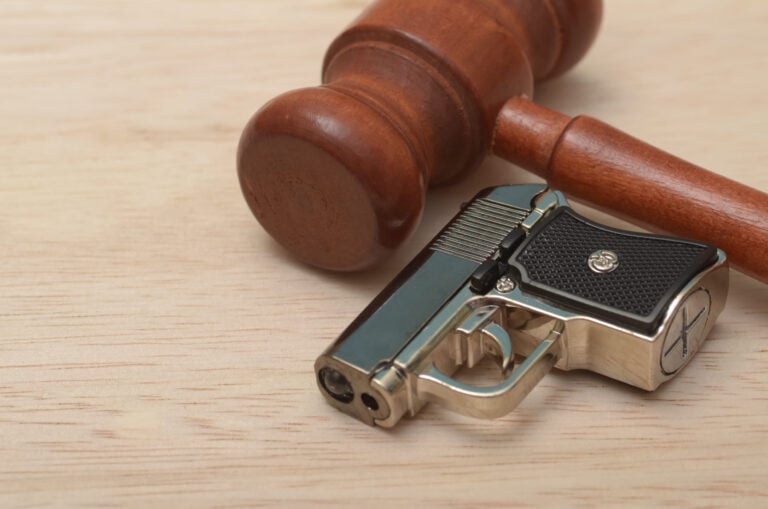
A routine traffic stop should not end in handcuffs. For some Mesa residents with prior felony convictions, that is exactly what happens. They believed their firearm rights were automatically restored when probation ended, only to discover during a background check or a police encounter that the record still shows them as restricted. If this has happened to you, a Mesa gun rights defense lawyer from Lerner and Rowe Law Group can review what happened and protect your rights and your record.
In this blog, a civil and gun rights restoration lawyer in Mesa walks through the most common sources of confusion around Arizona’s automatic restoration laws, what the State v. Begay firearm restoration decision means for your situation, why a Mesa set aside conviction alone will not get the job done, and what steps to take before you end up facing a Maricopa County prohibited possessor charge.
What Could Make You a Maricopa County Prohibited Possessor?
Arizona defines prohibited possessors under ARS 13-3101, which bars people with certain felony convictions from possessing firearms. The confusion is not usually about whether the law exists. It is about whether it still applies to a specific person, and two gaps cause most of the trouble:
- Unpaid restitution: The ARS 13-907 automatic restoration provision only applies when every condition of probation has been fully satisfied. A remaining restitution balance, even a small one, means the legal restoration has not occurred, regardless of how long ago probation supervision ended.
- Database delay: Even when rights are genuinely restored, Maricopa County law enforcement databases do not always reflect that update immediately. An outdated record can flag someone as restricted during a traffic stop or a background check at a gun store, creating a serious legal problem for someone who has actually done everything right.
A Maricopa County prohibited possessor charge is a Class 4 felony in Arizona, carrying real prison exposure and compounding the very record someone was working to move past. If you are unsure of your status, contact a Mesa gun rights defense lawyer at Lerner and Rowe Law Group now, before a traffic stop forces the issue.
What the State v. Begay Firearm Restoration Decision Means
The State v. Begay firearm restoration decision from the Arizona Court of Appeals addressed the intersection of Arizona’s civil rights restoration statutes and the federal prohibition on firearm possession by convicted felons. The question was whether a state-level restoration could also lift the federal firearm bar.
The court confirmed that Arizona’s restoration framework, when properly completed, can satisfy federal requirements. Under federal law, a prior conviction only continues to bar possession if the state’s restoration expressly excludes firearms. When Arizona restores rights without that carve-out, the federal prohibition is lifted.
What the decision also clarified is that the restoration must be complete and properly documented to count. An incomplete restoration, or one that was never recorded correctly, does not satisfy the federal standard. This is one of the strongest reasons to verify your status through official channels rather than assuming everything is resolved on its own. Your constitutional rights deserve documentation that holds up at both the state and federal levels.
A Mesa Set Aside Conviction Does Not Restore Arizona Felony Gun Rights
Arizona’s set-aside process under ARS 13-905 allows eligible individuals to petition the court to set aside their conviction and release them from related penalties and disabilities. It is a meaningful remedy, but it is not a restoration of firearm rights, and this aspect is where many people run into trouble.
The set-aside process and the Arizona felony gun rights restoration process are separate legal actions. A Mesa set aside conviction can support a subsequent petition for restoration and is often a useful first step, but completing one does not complete the other.
Set-asides are also not available for all conviction types. Certain dangerous offenses, sexual offenses involving minors, and other designated felonies are excluded from eligibility. And even for eligible convictions, the court has discretion to deny the petition based on the seriousness of the offense and conduct since sentencing.
If you received a set-aside years ago and assumed it resolved your Arizona felony gun rights, that assumption needs to be verified before you act on it. A petition filed with the Maricopa County Superior Court is the appropriate venue for Mesa residents, and legal representation through that process can significantly affect the outcome.
Why You Need a Mesa Gun Rights Defense Lawyer
The ARS 13-907 automatic restoration provision applies to first-time felony offenders who meet all of the following:
- Not convicted of a dangerous or serious offense
- Completed all terms of probation in full, including fines, fees, and restitution
When those conditions are met, civil rights, including firearm rights, are restored by operation of law at the end of probation, with no petition required. The full text of the statute is available through ARS 13-907 on the Arizona Legislature’s website.
The catch is that “automatic” does not mean the system knows it happened. The individual is responsible for confirming that their record reflects the restoration and that no outstanding obligations remain. Many people assume that finishing their probation supervision period is the same as finishing their probation obligations, and those two things do not always align.
For people who fall outside ARS 13-907, there is no automatic path. This includes those with:
- Repeat felony convictions
- Dangerous offense convictions
- Offenses specifically precluded by statute
A formal petition to the court is required, and approval is not guaranteed. The court weighs the nature of the offense, conduct since sentencing, and other factors before deciding. Anyone unsure which category they fall into should speak with a Mesa gun rights defense lawyer before drawing any conclusions. Possessing a firearm while still legally restricted can result in Mesa felony charges far more serious than the original conviction.
Steps to Take Before You Need a Mesa Gun Rights Defense Lawyer
The best time to clarify your firearm rights status is before a problem arises. These steps can tell you where things stand and, if there is a gap, give you time to address it with guidance from our legal team.
- Pull your sentencing records: Obtain copies of your original sentencing documents and probation termination paperwork to confirm all conditions were formally completed.
- Request your criminal history: Contact the Arizona Department of Public Safety (ADPS) for a copy of your record and check whether any firearm restrictions still appear.
- Confirm restitution was fully paid: Contact the court or your former probation officer to verify that no balance remains on any fines, fees, or restitution tied to your sentence.
- Get a legal opinion before acquiring a firearm: An attorney can review your full history and give you a clear answer about your current status before you take any action that could result in new charges.
Taking these steps now can prevent a traffic stop or background check from becoming the moment you find out your rights were never actually restored.
Contact a Mesa Gun Rights Defense Lawyer Today
Finding out your firearm rights were never properly restored, especially when you believed the matter was settled years ago, is a stressful situation that deserves a clear answer.
Our team is available 24/7 and offers payment plans to make sure cost is never a barrier to getting help.
Call (602) 667-7777, reach us via LiveChat, or fill out our secure online form to schedule your free, confidential consultation.
The information on this blog is for general information purposes only. Nothing herein should be taken as legal advice for any individual case or situation. This information is not intended to create, and receipt or viewing does not constitute, an attorney-client relationship.