
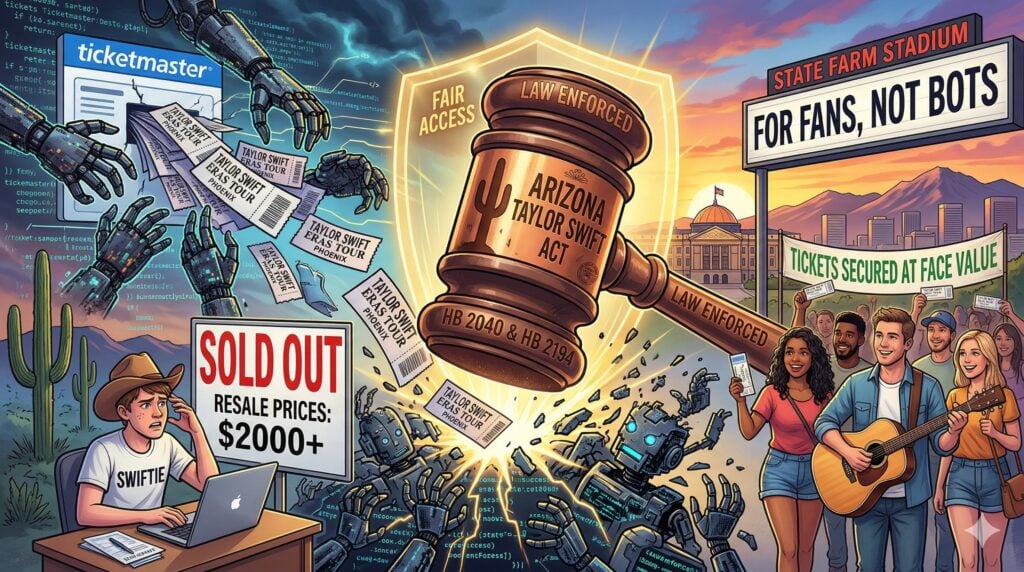
Getting tickets to a major concert at State Farm Stadium can make people feel bigger than the whole sky. Unfortunately, ticket bots have robbed fans of that feeling and increased prices for everyone. Thankfully, recent changes to Arizona law have made bot rigging illegal. The Arizona Taylor Swift Act was signed in 2024 specifically to stop automated software from buying tickets for popular shows. The accomplished Phoenix criminal defense lawyers from Lerner and Rowe Law Group explain the new law and how our team can protect you from Arizona ticket bot fraud charges.
Understanding the Arizona Taylor Swift Act
In May 2024, Governor Katie Hobbs signed House Bill 2040 into law. This amended ARS 44-7202 to ban the use of automated bots in Arizona’s ticket market. The legislation was a result of the bad blood generated by Taylor Swift’s 2022 tour presale. That year, thousands of Arizona Swifties sat in virtual lines for hours, hoping to get tickets to the Eras Tour. Unfortunately, many were unable to buy tickets due to bot activity. These programs purchased a large portion of tickets, primarily on behalf of bulk resellers.
Under the Arizona Taylor Swift Act, it is now unlawful to purchase tickets in excess of posted limits using bot software. Furthermore, the law made it illegal to cycle through multiple IP addresses, purchaser accounts, or email addresses to get around those limits. Lastly, defeating presale codes or security queues through software is prohibited.
A companion bill, HB 2194 (now ARS 44-8031), targets ticket resellers directly. It prohibits selling duplicate tickets, reselling before public on-sale dates, and listing tickets without disclosing the specific seat. Both of the statutes mentioned above authorize the Arizona Attorney General to investigate violations and pursue enforcement.
How a Phoenix Ticket Bot Operation Triggers Fraud Charges
Civil enforcement from the AG’s office is one thing. Criminal exposure is another.
A large-scale Phoenix ticket bot fraud operation can trigger computer fraud charges under ARS 13-2316 the moment a bot defeats a platform’s security controls. Many of these transactions cross state lines, which opens up federal wire fraud exposure on top of state charges.
Think about a bot running simultaneous presales for events at Mortgage Matchup Center and Chase Field. It rotates through hundreds of fake accounts and defeats security on multiple platforms at once. Prosecutors don’t see a single consumer protection violation; they see a criminal scheme with a documented pattern of conduct.
The Dangers for Small-Time Ticket Resellers
Not everyone caught up in a Phoenix ticket bot fraud investigation is running a sophisticated operation. Some defendants are casual resellers. They may have bought bot software online without understanding what it actually does to ticketing websites. Others bought seats for friends and exceeded posted limits through a third-party app.
You can be found guilty of fraud in seemingly innocent scenarios, like the ones mentioned above. Under ARS 44-7202, prosecutors focus on intent to circumvent purchase restrictions. The Arizona Taylor Swift Act doesn’t draw a line between enterprise scalpers and someone who used a bot once, so scale isn’t a deciding factor.
If you’ve been charged with ticket fraud, a skilled Phoenix criminal defense lawyer from Lerner and Rowe Law Group can evaluate whether your alleged conduct actually meets the statutory threshold.
Cybercrime Penalties Under the Arizona Taylor Swift Act
Violations of the Arizona Taylor Swift Act start with civil enforcement but can go beyond that.
When bot activity involves unauthorized access to a computer system, Arizona’s cybercrime statute supports felony charges. At the federal level, the BOTS Act carries civil fines up to $16,000 per violation per day. Investigators count every bot-assisted transaction separately, so those numbers compound fast.
For resellers, each prohibited transaction under HB 2194 can constitute a standalone consumer fraud violation under ARS 44-1522. High-profile Phoenix venues amplify the enforcement priority. For example, high-profile concerts at Ak-Chin Pavilion or games at Desert Diamond Arena draw public attention. That visibility matters to prosecutors building a case.
Challenging Digital Evidence and IP Tracking
Digital evidence drives every Phoenix ticket bot fraud prosecution. IP address logs, account creation timestamps, device fingerprints, purchase records–investigators stack all of it.
While that evidence looks solid, it rarely holds up under serious scrutiny.
However, IP addresses can be spoofed, proxies can confuse attribution entirely, and purchase logs confirm a transaction happened, but not who was controlling it. Additionally, account metadata can be corrupted or get obtained through investigative methods that don’t survive a suppression motion.
A savvy Phoenix criminal defense lawyer from Lerner and Rowe Law Group knows exactly where these digital chains break. Our attorneys have both the legal knowledge and the negotiating skills to take apart that evidence long before it reaches a jury.
Defense Strategies for the Arizona Taylor Swift Act
Every Arizona Taylor Swift Act case starts with one question: What does the prosecution actually have? From there, our team works through the key defense angles:
- Were digital records obtained through a properly issued and scoped warrant?
- Can IP or account data be cleanly attributed to the defendant, or is the attribution ambiguous?
- Did the defendant control the bot directly, or did third-party software act without direct user input?
- Was there actual circumvention of a security measure or simply high-volume purchasing that exceeded a posted limit?
- Is conduct being prosecuted as criminal when it only supports a civil violation?
An experienced Phoenix criminal defense lawyer from Lerner and Rowe Law Group will fight on every one of those fronts. Our history of winning favorable results for Phoenix-area clients speaks for itself. So do the hundreds of excellent reviews from people who trusted us when the stakes were highest.
Contact a Trusted Phoenix Criminal Defense Attorney 24/7
Don’t wait to build your ticket bot fraud defense. The Arizona Taylor Swift Act is actively enforced, and the Arizona AG’s office has broad investigative authority. Additionally, federal agencies are now coordinating BOTS Act enforcement at the highest levels of government. You can count on Lerner and Rowe Law Group to do everything possible to get your charges dropped or, at the very least, reduced.
The Arizona criminal defense attorneys at Lerner and Rowe Law Group are available 24/7 by phone at (602) 667-7777. You can also reach us online through our secure contact form or by speaking with our LiveChat agents. Consultations are free, confidential, and come with no obligation to hire us. Reach out to us today and let us start building your defense immediately.
The information on this blog is for general information purposes only. Nothing herein should be taken as legal advice for any individual case or situation. This information is not intended to create, and receipt or viewing does not constitute, an attorney-client relationship.