
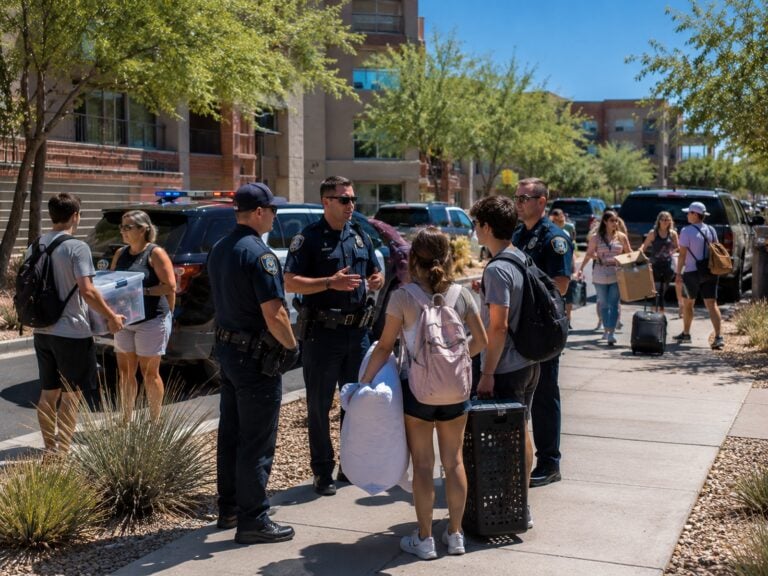
Every August, tens of thousands of students flood back into Tucson for move-in days and Wildcat Welcome, and the energy around campus is electric. But that same surge of people, packed parties, and late nights near 4th Avenue also brings a significant increase in law enforcement presence. A University of Arizona police interaction that starts over a noise complaint or an open container can escalate to handcuffs faster than most students realize, and the consequences of a resisting arrest charge can follow you long after the semester begins. If you or your student is facing charges after a Welcome Week encounter, the experienced Tucson resisting arrest lawyers at Lerner and Rowe Law Group can help you understand your options.
This post walks you through why back-to-school patrols in Tucson are especially intense, what the law actually says about resisting arrest in Arizona, and what steps to take if a Welcome Week run-in with law enforcement has turned into criminal charges.
Why Welcome Week Triggers More University of Arizona Police Interaction
The stretch of Welcome Week that coincides with University of Arizona move-in is one of the highest-volume periods for the Tucson Police Department and University of Arizona Police Department (UAPD) patrols.
Both agencies coordinate to cover off-campus housing areas and nightlife corridors where large groups of students congregate, including the 4th Avenue district, where 4th Avenue student arrests spike each August as crowds fill bars and sidewalks well past midnight.
Officers are specifically watching for alcohol-related offenses, noise ordinance violations, and disorderly behavior in these areas. Hosting or attending a party that draws a police response can quickly turn a minor citation into something more serious if any participant argues with or physically resists an officer. Law enforcement is trained to interpret pushback, even something as instinctive as pulling your arm away, as grounds for additional charges.
What Legally Constitutes Resisting Arrest Under Arizona Law
Most people assume that “resisting arrest” means fighting a police officer. Arizona law is considerably broader than that. Under A.R.S. 13-2508, a person commits resisting arrest when they intentionally prevent or attempt to prevent an officer from making a lawful arrest or detention by using or threatening physical force, creating a substantial risk of injury, or engaging in passive resistance.
That last element catches many students off guard. The statute defines passive resistance to include actions like:
- Going limp when an officer attempts to detain you
- Refusing to put your hands behind your back
- Bracing your body against being handcuffed
None of these require throwing a punch, and all of them can support a criminal charge.
Resisting arrest is typically a Class 1 misdemeanor in Arizona, which carries a potential sentence of up to six months in jail, probation, and fines. A skilled Tucson misdemeanor defense attorney can review exactly what occurred and assess whether the charge is legally supported. If force was used or threatened against an officer, the charge can escalate to a Class 6 felony.
How a University of Arizona Police Interaction Can Spiral Out of Control
The combination of adrenaline, alcohol, and crowds makes Welcome Week one of the most unpredictable settings for a police encounter. Officers responding to a noise violation or underage drinking report frequently make contact with multiple people at once, and the situation can become chaotic quickly. In that environment, a student who raises their voice, steps toward an officer, or tries to walk away may escalate the situation.
Arizona law does not require that you be under formal arrest for a resisting charge to apply. Detention, meaning any situation where a reasonable person would believe they are not free to leave, can be enough to trigger the statute.
Officers may also add a resisting charge on top of an underlying offense like disorderly conduct or a DUI when the interaction became tense, even if the underlying offense alone would have resulted in a citation.
The consequences can be especially serious for students, as a conviction can affect more than just a criminal record. A conviction can result in loss of financial aid eligibility and having to move off campus as well as potential impacts to future employment, especially in fields that require background checks.
Constitutional Rights During a University of Arizona Police Interaction
Knowing your rights before a University of Arizona police interaction occurs is one of the most important things a student can do. Those rights include:
- The right to remain silent beyond providing basic identifying information when lawfully detained
- The right to decline a consent search of your belongings or vehicle
- The right to remain calm and ask clearly, without aggression, whether you are free to leave
Invoking your constitutional rights does not make you appear guilty, and it does not give an officer grounds to escalate. What it does is protect your ability to mount a defense later. Also, remember to not discuss the details of the encounter with anyone other than your attorney. Statements made at the scene or afterward, even to friends, can surface in ways that complicate your case.
If you are placed under arrest, comply, and then immediately ask for legal representation. Resistance at that point, even verbal escalation, can result in additional charges being layered onto whatever brought officers to you initially.
What an ARS 13-2508 Defense Can Look Like
Know that a charge under A.R.S. 13-2508 is not automatically a conviction. There are several potential defense strategies an attorney may explore depending on the specific facts of your University of Arizona police interaction.
One of the most common arguments is that the underlying arrest or detention was itself unlawful. If an officer lacked reasonable suspicion or probable cause to detain you, any resistance to that unlawful detention may not satisfy the statute’s elements. Another avenue is challenging whether your conduct actually met the legal threshold for “resisting.” If what occurred was a reflexive, involuntary movement rather than an intentional act, that distinction matters under Arizona law.
Evidence review is also critical. Officers often wear body cameras, and proceedings in Pima County Superior Court may involve footage that tells a different story than what appears in the police report. A Pima County criminal attorney can subpoena that footage, interview witnesses, and build a timeline of events that supports your version of what happened.
Facing Charges after Welcome Week? Our Attorneys Can Help
A resisting arrest charge from a chaotic Welcome Week night does not have to define your college experience or your future. The experienced Tucson criminal defense lawyers at Lerner and Rowe Law Group understand how quickly these situations develop and what it takes to build a strong defense under Arizona law.
Our legal team is available 24/7 and offers payment plans to make qualified representation accessible.
Call (602) 667-7777, reach us via LiveChat, or fill out our secure online form to schedule your free, confidential consultation.
The information on this blog is for general information purposes only. Nothing herein should be taken as legal advice for any individual case or situation. This information is not intended to create, and receipt or viewing does not constitute, an attorney-client relationship.