
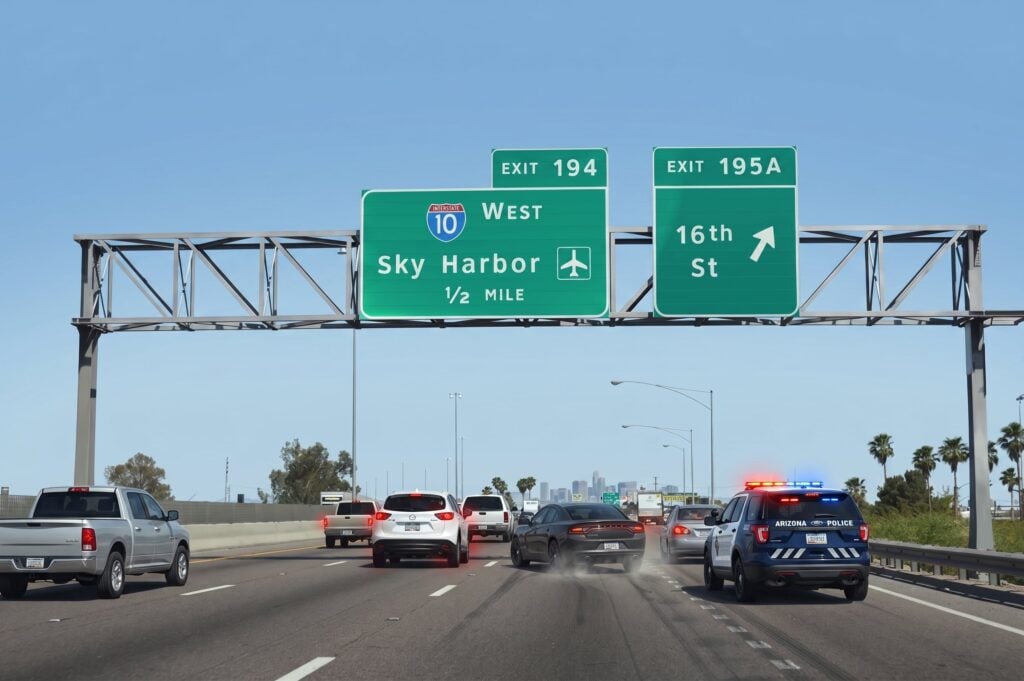
A broken taillight on the Black Canyon Freeway near Dunlap Avenue can end with a felony drug charge if an officer smells marijuana, spots a pill bottle on the seat, or talks you into consenting to a search. The I-17 corridor running through West Phoenix and Sunnyslope is one of the most actively patrolled stretches of freeway in the state, and drug arrests out of routine traffic stops happen on it constantly. A skilled Phoenix drug possession lawyer from Lerner and Rowe Law Group is ready to fight your I-17 drug arrest defense and protect your future. Read on for more details.
How Routine Traffic Stops Escalate on the Black Canyon Freeway
Phoenix PD and Arizona DPS run overlapping enforcement on the I-17 corridor between Dunlap Avenue and Camelback Road, one of the most drug-active stretches of freeway in the metro area. A lane drift, an expired registration, or a cracked windshield gives an officer a lawful basis to make a stop. From there, an odor claim, a visible item in the back seat, or a dog alert on the bumper becomes the basis for a full vehicle search. Officers working this corridor are trained to build that chain fast, and they do.
The Sunnyslope and Grand Canyon University corridor along 27th Avenue and Camelback sits directly off the I-17 on-ramps. Commuters, delivery drivers, students, and residents all use this stretch daily alongside everyone else. Drug arrests out of Black Canyon Freeway traffic stops sweep up first-time offenders with clean records as readily as anyone, and the charge that follows a vehicle search does not account for whether the person had any idea what they were being accused of.
The Critical Role of an I-17 Drug Arrest Defense Strategy
A Phoenix drug possession lawyer from Lerner and Rowe Law Group pulls dashcam and body camera footage from your stop before anything else. The officer’s report will describe a basis for the search.
The video frequently contradicts it: consent that was not freely given, a search that started before any articulable reasonable suspicion existed, or a K-9 alert staged after officers had already been through the center console. An I-17 drug arrest defense built on those facts has a real path to suppression, and suppression of the evidence often ends the case entirely.
Note that agreeing to a search does not waive your right to challenge it later. If consent was obtained through coercion, deception, or a false claim of authority, that consent is not legally valid. A skilled I-17 drug arrest defense attorney will examine the full sequence of the stop, from the moment the officer activated lights to the moment the drugs were allegedly found, looking for every break in the chain.
Understanding Drug Possession Under A.R.S. 13-3407
ARS 13-3407 covers possession of dangerous drugs in Arizona, including methamphetamine, prescription stimulants, benzodiazepines without a valid prescription, and other Schedule I and II controlled substances.
A first-time possession conviction is a Class 4 felony. When the quantity found exceeds the statutory threshold amounts under ARS 13-3401, the charge escalates to possession for sale or drug trafficking, both of which carry mandatory prison terms and are prosecuted far more aggressively.
Narcotics such as heroin and cocaine fall under ARS 13-3408 instead. The threshold amounts and penalty ranges differ between the two statutes, and an I-17 drug arrest defense lawyer who understands which statute applies to your specific substances and quantities can identify immediately whether the charge has been filed at the right level, and whether an argument for reduction is available from the outset.
Constructive Possession and Your I-17 Drug Arrest Defense
Phoenix vehicle search laws allow prosecutors to charge every occupant of a vehicle when drugs are found in a shared space, like a glove box, a center console, or under a seat. This is constructive possession: the theory that you had knowledge of the drugs and control over the space where they were found.
You do not need to have touched the drugs or known whose they were. Prosecutors must prove knowledge and argue constructive possession aggressively in multi-occupant vehicle stops on the I-17 corridor, and it results in charges against passengers who had no connection to the contraband at all.
Lerner and Rowe Law Group’s accomplished Phoenix felony defense attorneys handle I-17 drug arrest defense cases arising from:
- Traffic stops where the vehicle search lacked valid consent, a warrant, or a recognized exception to the warrant requirement
- Constructive possession charges where the defendant did not own the vehicle or had no knowledge of the drugs
- Cases where the K-9 alert or field test result is the primary evidence and is vulnerable to challenge
- Threshold amount allegations where the weight calculation is disputed or the substances were improperly tested
- Charges stacked with driving on a suspended license or other traffic violations from the same stop
Your Fourth Amendment Rights Against Illegal Vehicle Searches
The Fourth Amendment protects you against unreasonable searches and seizures. On the I-17, that protection applies to your vehicle the same way it applies to your home, with some exceptions that officers and prosecutors rely on heavily.
The automobile exception allows a warrantless search when officers have probable cause to believe the vehicle contains contraband. The consent exception allows a search when the driver or occupant voluntarily agrees. Exigent circumstances, plain view, and search incident to arrest round out the common bases officers use to justify a vehicle search without a warrant.
Fighting drug charges in Arizona after an I-17 traffic stop means attacking whichever exception the officer claims. Probable cause requires objective, articulable facts, not just a hunch. An odor claim is not automatically sufficient.
A dog alert is not automatically valid. Plain view requires the item to be immediately recognizable as contraband from a lawful vantage point. Each of those standards gives a skilled defense attorney a genuine argument, and arguments that succeed at a suppression hearing keep drug charges from ever reaching a jury.
How Our I-17 Drug Arrest Defense Attorneys Suppress Evidence
A motion to suppress evidence challenges the legality of the search and asks the court to exclude everything found as a result of it. When a judge grants suppression in an I-17 drug case, the prosecution loses its primary evidence. Most cases do not survive that loss. Our attorneys file suppression motions early, before any plea negotiation begins, so the prosecution understands from the start that the evidence is at risk.
Our team also challenges the chain of custody for seized substances, the accuracy of field tests and laboratory results, and the officer’s credibility where the body camera footage contradicts the written report. Prosecutors at Maricopa County courts know our attorneys file these challenges early and follow through on them at hearing. Phoenix drug possession lawyer cases from the I-17 corridor resolve more favorably when the prosecution knows the evidence has been scrutinized before they make their first offer.
Protect Your Freedom with a Phoenix Drug Possession Lawyer
An I-17 drug arrest defense case is not over just because the officer found something in your car. You can trust the experienced Phoenix drug possession lawyer team at Lerner and Rowe Law Group to build you the defense you need to win a favorable result in Maricopa County courts. Reach out to us today to schedule your confidential and free consultation.
The Phoenix criminal defense attorneys at Lerner and Rowe Law Group are available 24/7 by phone at (602) 667-7777. You can also reach us through our secure contact form or by speaking directly with our LiveChat representatives.
The information on this blog is for general information purposes only. Nothing herein should be taken as legal advice for any individual case or situation. This information is not intended to create, and receipt or viewing does not constitute, an attorney-client relationship.