
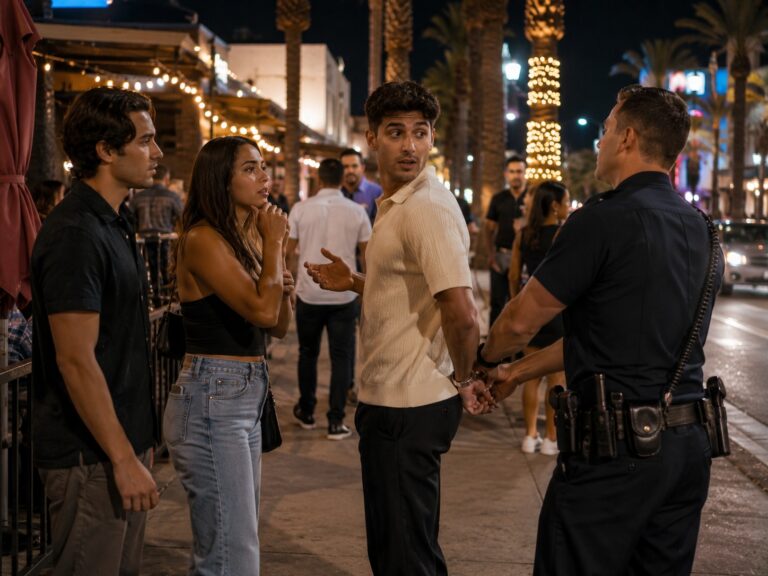
As temperatures cool down in September and October, the clubs, bars, and sidewalks in Old Town Scottsdale fill with weekend crowds. With this comes more crowds and more opportunities for police interactions. Mixing alcohol in this high-energy environment can mean these interactions can quickly turn into altercations. Many times, these situations can involve resisting arrest, which is more than attempting to strike an officer or trying to flee. A police altercation arrest in Scottsdale, AZ, can begin with a minor disagreement near Saddlebag Trail and end with an allegation that someone pulled away, stiffened an arm, or refused an officer’s command. A Scottsdale criminal defense lawyer from Lerner and Rowe Law Group can help evaluate what actually happened during those chaotic few minutes.
This blog explains how Old Town police interactions escalate, what A.R.S. 13-2508 prohibits, the potential consequences, and how an attorney may challenge an exaggerated account.
What Counts as Resisting Arrest Under ARS 13-2508?
Arizona Revised Statutes 13-2508 defines resisting arrest as intentionally preventing or attempting to prevent an officer from making an arrest through one of three types of conduct:
- Assaulting the officer or another person
- Using another means that creates a substantial risk of physical injury
- Engaging in passive resistance
The statute defines passive resistance as a nonviolent physical act, or failure to act, intended to impede, hinder, or delay an arrest. This definition is broad, but it does not eliminate the intent requirement. The prosecution must show that the accused intentionally tried to interfere with the arrest.
Arguments, questions, confusion, or slow compliance alone do not necessarily prove intent. In a loud club environment, a person may not hear an order, which can lead to confusion and actions that others may take out of context. Someone unexpectedly grabbed from behind and reflexively pulled an arm away. Intoxication, fear, an injury, or difficulty understanding conflicting commands may also affect how the encounter looks on video.
A police altercation arrest in Scottsdale AZ therefore requires a close, second-by-second review. When the initial contact involved allegations of fighting, threatening behavior, or disturbing the peace, you might also be facing a disorderly conduct charge. No matter what type of charge you are facing, a Scottsdale criminal defense lawyer
How a Police Altercation Arrest in Scottsdale Escalates
The Entertainment District combines loud music, crowded sidewalks, alcohol, security personnel, rideshare traffic, and police activity into a relatively small area. When a dispute starts inside a club, a bouncer may remove someone before officers arrive. Police then enter a situation where several witnesses are talking at once and everyone may have a different version of events.
Scottsdale requires certain businesses that offer live entertainment or a DJ to maintain public safety plans and provide mandatory training for security personnel in order to keep public safety intact in nightlife venues.
An Entertainment District police encounter may escalate through a sequence like this:
- Club security removes a patron after an argument or alleged fight.
- An officer orders that person to leave the property.
- The person argues, asks why they are being detained, or tries to retrieve friends or belongings.
- An officer attempts to place the person in handcuffs.
- A startled movement, tense arm, or effort to turn around is described as resistance.
Officers may have only seconds to assess the scene. That does not mean their first interpretation is always complete. A Scottsdale resisting arrest lawyer can compare the police narrative with body-camera video, surveillance footage, and witness accounts to determine the what actually happened.
When a Police Altercation Arrest in Scottsdale, AZ Becomes a Felony
Not every resisting arrest allegation ends in a felony charge. The classification depends on the conduct prosecutors claim occurred.
Resisting through physical force, a threat of physical force, or conduct that creates a substantial risk of injury is a Class 6 felony. Passive resistance is a Class 1 misdemeanor. The distinction matters because a broadly worded report may characterize a reflexive or defensive movement as force.
For example, prosecutors might argue that pulling away caused an officer to lose balance or created a risk of injury on a crowded sidewalk. The defense may contend that the movement was momentary, involuntary, or caused by the officer’s positioning. A stiff arm could be described as an intentional attempt to defeat handcuffing, or it could reflect panic, pain, or confusion.
A Class 6 felony is Arizona’s lowest felony classification, but it remains serious. Depending on the person’s record and the facts, possible consequences can include probation, incarceration, fines, and a lasting criminal record. A Scottsdale felony lawyer can explain the potential sentencing range and whether any alternative classification or resolution may apply.
Other allegations may accompany the resisting charge. A Saddlebag Trail club arrest could also involve assault, trespassing, criminal damage, or disorderly conduct. Each accusation has separate elements, and the state must prove each one beyond a reasonable doubt.
Evidence That May Contradict the Police Report
A police report reflects the officer’s account, but it is not the only evidence. Nightlife cases often involve several cameras and witnesses. Preserving that information quickly can be critical because a club or nearby business may not retain surveillance recordings indefinitely.
Potential evidence may include:
- Police body-camera and patrol-car video
- Club security recordings
- Cellphone videos from patrons or bystanders
- Dispatch audio and radio traffic
- Statements from friends, employees, security personnel, and rideshare drivers
- Photographs of injuries
- Medical records showing a shoulder, wrist, or mobility condition
- Records identifying when warnings and commands were given
Video may reveal whether commands were audible, whether multiple officers spoke at the same time, how quickly physical contact began, and whether the accused had a realistic opportunity to comply. It may also show conduct omitted from a written report.
The defense should consider the entire sequence, not just a few seconds after officers used force. If evidence was obtained through an unlawful search, improper questioning, or another violation of the accused’s constitutional rights, an attorney may determine whether a motion or other legal challenge is appropriate.
Defenses to a Police Altercation Arrest in Scottsdale, AZ
There is no one-size-fits-all defense to a resisting arrest charge. An attorney can review the video, witness statements, police reports, and the details of the encounter to determine what the evidence actually shows.
- The officer may not have been clearly identified: In a dark, crowded venue, the state may have difficulty proving that the person knew, or reasonably should have known, an officer was making the arrest.
- The movement may have been reflexive: Pulling away after unexpected contact, losing balance, or reacting to pain does not automatically show an intentional effort to resist.
- The commands may have been hard to hear: Loud music, crowd noise, stress, and conflicting instructions can make it difficult to understand what an officer is asking someone to do.
- The conduct may not support a felony charge: Briefly tensing, turning, or pulling away may not amount to physical force or conduct that created a substantial risk of injury.
- Video or witnesses may provide a different perspective: Body-camera footage, club recordings, and bystander accounts can provide context that is missing from a police report.
- Excessive force may matter: Although a person generally cannot use force simply to resist an arrest, evidence that an officer used excessive force may affect the credibility of the police account and raise constitutional issues.
- The original altercation may be disputed: If the arrest followed an alleged shove involving a bouncer or patron, a Scottsdale assault defense lawyer can assess self-defense, mistaken identity, witness reliability, and whether the evidence supports a separate assault charge.
A careful review of the evidence can help your attorney build a defense that reflects your side of the encounter and challenges unsupported allegations.
Contact a Scottsdale Resisting Arrest Lawyer Near Me
A resisting arrest charge can put your record, career, and future at risk. The details of the encounter can matter just as much as the charge itself, especially when the police report does not tell the full story.
An East Valley criminal defense attorney from Lerner and Rowe Law Group can look closely at the evidence, including video, witness accounts, and the details leading up to the arrest. Your attorney may be able to challenge the felony allegation, question the state’s evidence of intent, work with prosecutors, or take the case to court when appropriate.
Our team is available 24/7 and offers payment plans. Call (602) 667-7777, reach us via LiveChat, or fill out our secure online form to schedule your free, confidential consultation.
The information on this blog is for general information purposes only. Nothing herein should be taken as legal advice for any individual case or situation. This information is not intended to create, and receipt or viewing does not constitute, an attorney-client relationship.