
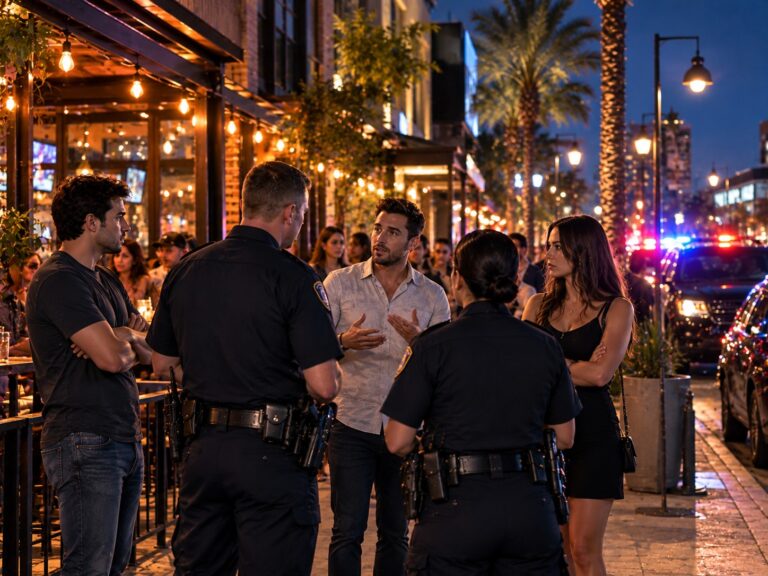
A weekend in Downtown Mesa, Mesa Riverview, or near the Salt River can get loud quickly. A disagreement outside a bar, a tense exchange in a parking lot, or a scuffle at a gathering may draw police attention. At that moment, a disturbing the peace arrest in Mesa can turn a heated night into a criminal case. A Mesa disorderly conduct lawyer can help an accused person understand the charge and the legal process ahead.
Disorderly conduct is often treated as a broad charge, but Arizona law still requires the state to prove particular conduct and a required mental state. This blog explains what the statute covers, why evidence matters in crowded nightlife cases, and how an attorney may review the state’s allegations.
Disturbing the Peace Arrest in Mesa
Arizona’s disorderly conduct statute, A.R.S. 13-2904, applies when a person intends to disturb the peace or quiet of a neighborhood, family, or person, or knows that their conduct will do so. The statute lists specific conduct, including fighting, unreasonable noise, abusive language likely to provoke immediate physical retaliation, disrupting a lawful gathering, refusing a lawful emergency-dispersal order, or recklessly handling a weapon.
Most allegations under the statute are Class 1 misdemeanors. Disorderly conduct involving the reckless handling, display, or discharge of a deadly weapon or dangerous instrument is a Class 6 felony. That difference makes the exact police allegation important.
A disturbing the peace arrest in Mesa may arise from something police describe as loud, confrontational, or disruptive. The phrase “Maricopa County catch-all crime” is sometimes used to describe disorderly conduct because it can appear in many types of reports, but the charge is not automatic. Prosecutors must still connect the evidence to a specific part of the statute.
An allegation may lead to a police investigation, witness interviews, a review of video, and a court date. A Mesa criminal defense lawyer can explain how the underlying allegation and the available evidence may affect the case.
Evidence in a Disturbing the Peace Arrest in Mesa
In a crowded setting, a police report may capture only one officer’s view of a fast-moving situation. A Downtown Mesa bar fight charge may involve security staff, friends, bystanders, bartenders, rideshare drivers, and several people using their phones at once. Their accounts may not match.
Useful evidence may include:
- Security-camera footage from the venue or nearby businesses
- Cellphone video from people who witnessed the encounter
- Dispatch audio and the timing of calls for service
- Statements from staff, friends, and bystanders
- Photos showing the setting, injuries, or the crowd’s location
- Messages or rideshare records that help establish a timeline
The difference between a frustrating public interaction and criminal disorderly conduct can depend on details that are easy to miss in an initial report. Arizona’s law does not make every loud conversation, insult, or disagreement a crime. The state must identify the conduct it believes violated the statute and prove the required intent or knowledge.
For example, a person may be accused of unreasonable noise after security asks a group to leave a venue. The relevant questions may include how loud the group was, how long the noise continued, whether nearby people were actually disturbed, and whether the person received clear directions. In another case, an officer may describe a heated argument as seriously disruptive behavior, while video or witness accounts show that the accused was attempting to leave or de-escalate the situation.
A Downtown Mesa bar fight charge can also involve uncertainty about who started the physical contact and whether every person named in the report actually participated. A witness who saw only the end of an argument may have a different perspective from someone who watched the entire exchange. Security footage may show whether a person was pushed, surrounded, trying to separate friends, or reacting to a sudden confrontation.
Context matters, however. A loud disagreement is not necessarily unreasonable noise under the statute, and an argument does not automatically establish fighting or seriously disruptive behavior. If police also allege assault, the state must prove the separate elements in A.R.S. 13-1203. A Mesa assault defense lawyer can assess how the evidence relates to that separate allegation.
Police Discretion Does Not Replace Proof
Police officers may need to make quick decisions when a crowd is growing or an argument is escalating. Still, an arrest does not answer every factual question. A person may have been trying to leave, trying to calm someone else down, or reacting to conduct that the report did not fully reflect.
Police reports often use broad descriptions such as “unruly,” “aggressive,” or “causing a disturbance.” Those labels may reflect an officer’s impression, but they do not replace the statutory elements. A defense attorney can compare those descriptions with body-camera video, dispatch audio, surveillance footage, and witness statements to determine whether the report is complete.
An A.R.S. 13-2904 defense East Valley case may involve reviewing whether the state can prove intent or knowledge, whether the alleged conduct actually fits the statute, and whether the available video supports the report. An Arizona criminal defense attorney may also examine whether officers had a clear view of the entire encounter and whether any statements or evidence were obtained lawfully.
A disturbing the peace arrest in Mesa can also raise questions about whether the accused person was actually participating in the alleged disruption. In a crowded setting, someone may be trying to leave, separate friends, or respond to another person’s conduct. Body-camera video, surveillance footage, and witness accounts can help show the full sequence rather than only the moment police arrived.
How Location May Impact a Disorderly Conduct Arrest
The location of the alleged conduct may matter as well. A complaint from a Downtown Mesa business, apartment complex, or parking lot may describe noise or behavior differently from what surrounding video shows. An attorney can compare the report with the available evidence and determine whether the state can prove the statutory elements beyond a reasonable doubt.
Call a Lawyer after a Disturbing the Peace Arrest in Mesa
A disorderly conduct arrest can affect your job, professional license, housing, and reputation, even when the incident began with a brief disagreement. Lerner and Rowe Law Group can review the facts, identify available evidence, and help you understand your options.
Our team is available 24/7 and offers payment plans. Call (602) 667-7777, reach us via LiveChat, or fill out our secure online form to schedule your free, confidential consultation.
The information on this blog is for general information purposes only. Nothing herein should be taken as legal advice for any individual case or situation. This information is not intended to create, and receipt or viewing does not constitute, an attorney-client relationship.