
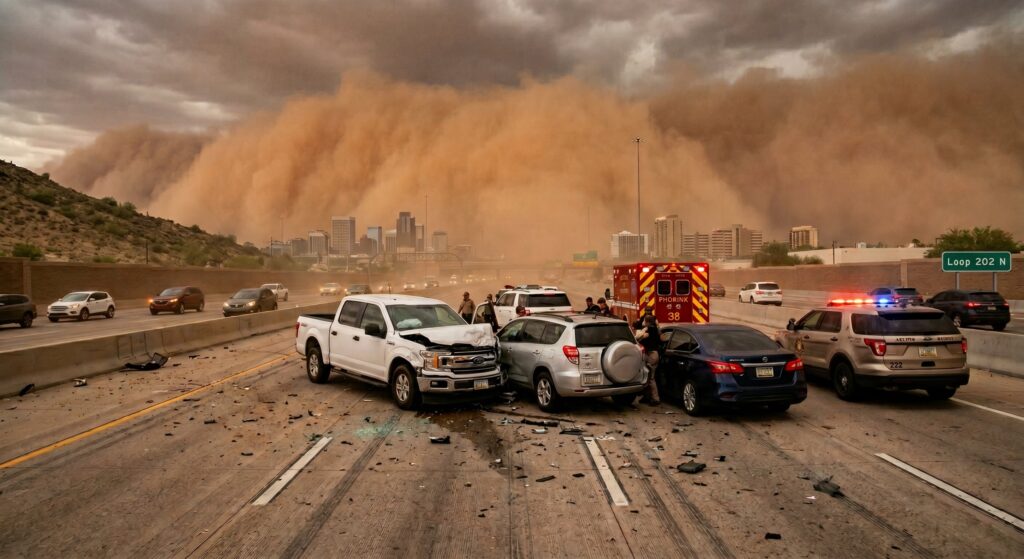
The Arizona monsoon season runs from mid-June through September, and the storms it produces can drop visibility on the I-10 to near zero within minutes. Arizona Department of Public Safety (DPS) officers patrol major corridors aggressively during peak weather events, and drivers caught in deteriorating conditions can face reckless driving charges under ARS 28-693 even when they believe they are driving carefully. If you’re facing such charges, a skilled Phoenix reckless driving lawyer from Lerner and Rowe Law Group is here to defend your rights and protect your record.
Severe Weather Highway Enforcement
Arizona DPS concentrates enforcement on the valley’s highest-risk monsoon corridors during storm activity. The I-10 between the Chase Field interchange and the Loop 202 split is one of the most active enforcement stretches in the state during August haboobs. Officers watch for vehicles maintaining highway speeds during reduced-visibility events, abrupt lane changes on rain-slicked pavement, and failure to use headlights during heavy downpours. A Maricopa County reckless driving citation from any of those observations carries real criminal consequences.
Arizona’s “Pull Aside, Stay Alive” public safety campaign tells drivers to exit the roadway and turn off their lights during zero-visibility dust storms. Drivers who pull onto the shoulder and leave lights on have been rear-ended by other drivers following the glow. Officers who arrive after a storm-related collision often cite the vehicles involved with reckless driving regardless of who initiated contact.
Driving During the Arizona Monsoon Season
The National Weather Service Phoenix (NWS) issues severe thunderstorm and dust storm warnings throughout the Arizona monsoon season, often with less than 15 minutes of advance notice. Haboob walls can move at 60 miles per hour. A driver who was navigating clear highway conditions when they passed the I-10 and 35th Avenue interchange can find themselves inside a zero-visibility dust cloud before the next exit. Officers documenting the aftermath of a storm passage write their reports based on conditions at the time of the stop, not the conditions the driver faced two minutes earlier.
Haboob driving laws in Phoenix require drivers to exercise reasonable care when road conditions change. What “reasonable care” looks like during a fast-moving storm is a fact question your Arizona defense attorney argues with weather data, radar records, and dashboard camera footage. An I-10 dust storm accident scene tells only part of the story.
What Constitutes Reckless Driving in Arizona?
ARS 28-693 defines reckless driving as operating a vehicle in reckless disregard for the safety of persons or property. The statute does not set a specific speed or enumerate specific behaviors. It leaves the determination to the officer’s judgment. During the Arizona monsoon season, that discretion is applied broadly. Traveling at the posted speed limit through a dust storm, following a vehicle at a standard highway distance during a downpour, or changing lanes to avoid standing water can all produce a reckless driving citation depending on who is watching.
ARS 28-693 is not a traffic infraction. It is a criminal misdemeanor charge often cited alongside DUI citations in many storm-related stops where an officer suspects impairment contributed to the driving behavior. Both charges flow from the same stop, and both require independent legal challenges.
A.R.S. 28-693 and the Arizona Monsoon Season
The ARS 28-693 defense argument most likely to succeed during a monsoon-related stop is that the defendant’s driving did not rise to the level of “reckless disregard.” Reckless disregard requires a conscious, unjustifiable decision to create a substantial risk. A driver who slowed from highway speed, activated hazards, and attempted to exit the roadway during a sudden haboob was not acting with reckless disregard, regardless of how an officer characterized the scene after the fact.
Weather records from the NWS, radar loop captures at the time of the stop, and any available traffic camera footage from the Arizona Department of Transportation all become evidence in an ARS 28-693 defense. A Phoenix reckless driving lawyer who understands how to obtain and present that evidence can fundamentally change the prosecution’s case before trial.
Penalties for a Class 2 Misdemeanor
ARS 28-693 is a Class 2 misdemeanor. Conviction can produce:
- Up to four months in jail
- Fines and surcharges reaching $1,500
- A driver’s license suspension of up to 90 days
- Escalation to a Class 1 misdemeanor on a second conviction within 24 months
- A Class 6 felony charge on a third conviction within 36 months
A reckless driving conviction stays on your criminal record permanently and adds points to your Arizona driver’s license. Insurance carriers treat it as a major moving violation and raise premiums for three or more years. Employers, landlords, and professional licensing boards can all see it on a standard background check.
Defending Arizona Monsoon Season Charges
Lerner and Rowe Law Group’s experienced Phoenix criminal defense attorneys handle Arizona monsoon season reckless driving cases arising from:
- I-10 dust storm accident scenes where the officer’s report characterizes normal defensive driving as reckless
- Speed-based citations where the driver was traveling at or near the posted limit during a rapidly deteriorating storm
- Lane-change citations on rain-slicked roads where the movement was a reasonable response to a road hazard
- Failure-to-stop citations under Arizona’s Pull Aside, Stay Alive standard where the driver was unable to safely reach the shoulder
- Reckless driving charges filed alongside DUI or criminal speeding citations from the same monsoon-related stop
Our attorneys secure National Weather Service records, ADOT traffic camera footage, and Arizona DPS officer body camera video before any of it is overwritten. That evidence frequently tells a story about the storm conditions that the officer’s written report does not capture.
Fighting Subjective Officer Opinions
The core challenge in every Arizona monsoon season reckless driving case is that the charge rests entirely on what the officer believed about the driver’s state of mind. “Reckless disregard” is not a speed reading. It is not a documented behavior. It is an officer’s interpretation of a scene they encountered during or after a weather event, and officers are working from what they found after the storm passed, not from what the driver faced when conditions changed.
A police report written at the scene captures airbags deployed, skid marks, and vehicles stopped in the median. What it does not capture is the radar loop showing a haboob wall moving at 60 miles per hour through that exact location two minutes before the stop. Our attorneys bring that weather record to the prosecutor at Maricopa County courts before a trial date is ever set.
How an Arizona Monsoon Season Lawyer Can Help You
A defense built on the officer’s subjective opinion is only as strong as the evidence that challenges it. Our team obtains the radar loop at the exact GPS coordinates and exact time of the stop. We pull the body camera footage. We request the officer’s training records on adverse weather enforcement. We identify every factual gap between what the report says and what the data shows.
If the case does not resolve through suppression or dismissal, we present that evidence at trial and argue the reckless disregard standard directly. Many Arizona monsoon season reckless driving charges that looked airtight at booking come apart when the weather record is placed next to the officer’s characterization of the scene. Check our documented history of superior case results to see how often these charges resolve in our clients’ favor.
Call a Phoenix Reckless Driving Lawyer Near Me
An Arizona monsoon season reckless driving charge is not a routine traffic citation. You can trust the experienced Phoenix criminal defense attorneys at Lerner and Rowe Law Group to build you the defense you need and deliver the results you want. Reach out to us today to schedule your confidential and free consultation.
Our Arizona criminal defense attorneys are available 24/7 by phone at 602-667-7777. If you prefer online contact, you can also reach us through our encrypted contact form or by speaking directly with our LiveChat representatives.
The information on this blog is for general information purposes only. Nothing herein should be taken as legal advice for any individual case or situation. This information is not intended to create, and receipt or viewing does not constitute, an attorney-client relationship.