
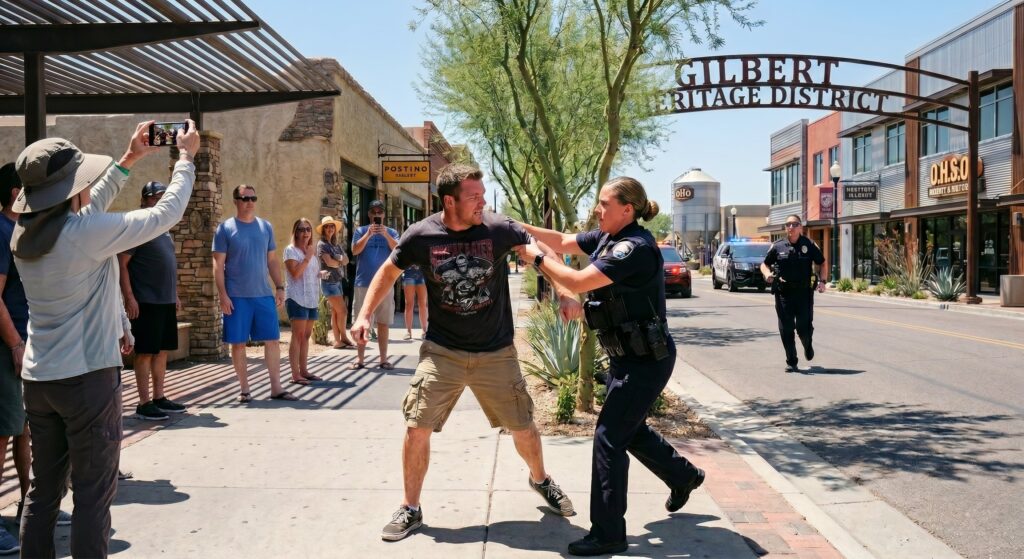
Late summer weekend nights bring thousands of people to the Gilbert Heritage District’s bars and restaurants, and Gilbert PD deploys heavy patrols to match the crowds. A Heritage District arrest for aggravated assault on a peace officer can follow a single reflexive gesture during a chaotic crowd encounter, and the felony that results carries mandatory prison time with no probation option. A skilled Gilbert aggravated assault on a police officer lawyer from Lerner and Rowe Law Group is ready to fight your charges and protect your future. Read on to learn how our Arizona attorneys can help you.
2026 Downtown Gilbert Police Patrols
Gilbert PD’s summer patrol deployment in the Heritage District is one of the most concentrated enforcement operations in the East Valley. Officers work the stretch between Gilbert Road and Greenfield Road on foot and in vehicles Friday and Saturday nights, and they respond to disturbance calls within minutes. A Downtown Gilbert police interaction that begins as a verbal warning can become an arrest in under a minute if an officer perceives any physical contact.
Nightlife Crowds and the Heritage District Arrest
The crowds outside Dierks Bentley’s Whiskey Row and The White Rabbit press together along the Heritage District sidewalks on peak summer nights. Two people arguing in a doorway, a group spilling onto the street, or someone physically contacted by an officer during a dispersal order are all scenarios that have produced Heritage District arrests under Arizona’s zero-tolerance officer contact statute.
Note that a Heritage District arrest for aggravated assault on an officer does not require a fight. It does not require intent to harm. It requires only that a person made intentional physical contact with an officer while knowing they were an officer. Under that standard, pulling a hand away during a detainment is enough.
What Triggers a Heritage District Arrest?
Most Heritage District arrests for assault on a peace officer begin with a lower-level incident. A verbal altercation draws an officer’s attention. The officer intervenes and attempts to physically separate the parties or detain one of them. The person being detained reacts by pulling away, bracing against the officer’s movement, or instinctively pushing back. That reaction, which takes a fraction of a second and rarely involves any intent to harm, produces a felony charge before the person fully understands what happened.
How Minor Bar Altercations Escalate
The pattern in Heritage District cases is consistent. Someone is asked to leave a venue. They argue with staff. An officer arrives. The officer attempts to escort the person out. The person resists, even mildly. The charge that follows is not a misdemeanor simple assault. It is a Class 5 felony under ARS 13-1204 for intentional contact with a peace officer, or a Class 6 felony for resisting an officer in Gilbert, AZ under ARS 13-2508. Two separate felony charges from one thirty-second encounter.
Surveillance footage from Heritage District venues, body camera footage from the responding officer, and witness accounts from people standing nearby frequently tell a different story than the arrest report. Getting a defense attorney into the case before arraignment is what keeps that evidence accessible and preserves your options.
ARS 13-1204 and Officer Contact
ARS 13-1204 makes it a Class 5 felony to intentionally, knowingly, or recklessly make physical contact with a peace officer engaged in official duties when the defendant knows or reasonably should know the person is an officer. No injury is required. No weapon is required. The moment of contact is the charge. When the contact causes serious physical injury, the offense escalates to a Class 3 felony with a presumptive prison term of 3.5 years.
ARS 13-2508 charges for resisting arrest frequently accompany 13-1204 charges out of the same incident. The two statutes address overlapping conduct, and prosecutors file both when the facts allow. Resisting with physical force is a Class 6 felony on its own. Stacked with the 13-1204 charge, the defendant faces two open felony files from a single encounter at a Heritage District bar.
Felony Charges for Touching an Officer
The ARS 13-1204 felony defense argument that succeeds most often challenges two elements: whether the defendant actually knew the person was a peace officer at the moment of contact and whether the contact was intentional or an involuntary reaction to being grabbed.
In a crowded bar environment at midnight, with music playing and multiple simultaneous physical interactions, the prosecution’s account of intentional conduct is not always what the body camera shows. An ARS 13-1204 felony defense attorney who secures that footage before it is overwritten can contest the prosecution’s version directly.
Officers in plainclothes or who have not clearly identified themselves at the moment of contact present an additional defense argument. A Heritage District arrest where the officer was not in uniform and identification was unclear is a factual dispute your attorney can raise at every stage of the proceeding.
Penalties for a Heritage District Arrest
A Class 5 felony conviction under ARS 13-1204 carries a presumptive term of two years in state prison for a first offense, with a range of 1.5 to 2.5 years. When the charge is designated dangerous because of officer contact, probation is unavailable. A Class 3 felony conviction carries a presumptive term of 3.5 years. A conviction at either level strips firearm rights, voting rights, and triggers mandatory disclosure on every professional license, security clearance, and employment background check.
Fighting Aggravated Assault Charges in Arizona
Lerner and Rowe Law Group’s experienced Gilbert defense attorneys handle Heritage District arrest cases arising from:
- Officer contact during a bar dispersal or escort where the defendant’s reaction was involuntary or defensive
- Plainclothes officer contact where identification was unclear at the moment the contact occurred
- Stacked ARS 13-1204 and ARS 13-2508 charges from the same Heritage District incident
- Surveillance or body camera footage that contradicts the officer’s written account of the physical contact
- First-time offenders facing a first Heritage District arrest where diversion or reduction is a realistic outcome
Our attorneys challenge whether the contact was intentional, whether the officer’s identification was clear, and whether the prosecution’s dangerous offense designation is supported by the facts. A Maricopa County criminal attorney who understands how Gilbert PD structures its Heritage District enforcement reports knows exactly where those reports leave gaps. We raise those challenges early at Maricopa County courts, before the prosecution’s version of events becomes the default record.
Call a Trusted Heritage District Arrest Defense Attorney
A Heritage District arrest does not have to become a permanent felony conviction. You can trust the experienced Gilbert criminal defense attorneys at Lerner and Rowe Law Group to build you the defense you need and deliver the results you want. Check our documented history of superior case results. Reach out to us today to schedule your confidential and free consultation.
Our Arizona criminal defense attorneys are available 24/7 by phone at (602) 667-7777. If you prefer online contact, you can reach us through our encrypted contact form or by speaking directly with our LiveChat representatives.
The information on this blog is for general information purposes only. Nothing herein should be taken as legal advice for any individual case or situation. This information is not intended to create, and receipt or viewing does not constitute, an attorney-client relationship.