
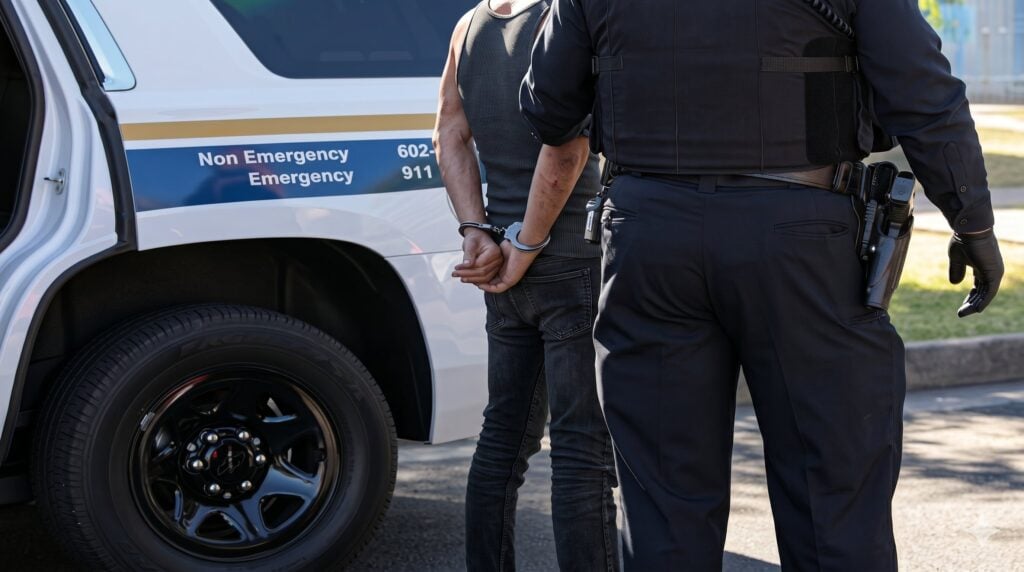
Leaving Westgate Entertainment District on a Saturday night and merging onto the Loop 101 puts you on one of the most actively patrolled freeway corridors in the West Valley. Glendale PD and Arizona DPS run enforcement on every Westgate-area on-ramp, and a minor lane infraction can turn into a vehicle search and a felony drug possession charge in a matter of minutes. A skilled Glendale drug crimes lawyer from Lerner and Rowe Law Group is ready to build your Loop 101 drug arrest defense and fight for your future. Read on to learn how our Arizona attorneys can help you.
How Westgate Traffic Stops Escalate on the Freeway
Venues like State 48 Funk House Brewery and Bar Louie keep the Westgate exits busy until well past midnight on game days and weekends. Officers working the Loop 101 between Glendale Avenue and Northern Avenue know that traffic, and they watch for anything that gives them a lawful basis to make a stop, such as a late signal, a wide merge, or a cracked license plate light.
A Westgate traffic stop drug charge develops fast once an officer makes contact. An odor claim, a visible item on the seat, or a passenger’s nervous behavior gives the officer grounds to extend the stop and request consent to search. Many drivers agree to the search, believing refusal looks suspicious. They do not realize that refusing consent is a constitutional right, and a Loop 101 drug arrest defense attorney from Lerner and Rowe Law Group will use that refusal and any illegal search as the foundation of your defense.
The Urgency of a Loop 101 Drug Arrest Defense Strategy
Glendale PD and DPS officers wear body cameras, and their dashcams record from the moment lights activate. That footage captures the full stop, from the stated reason for the pull-over, the conversation at the window, and everything that preceded the search. Our knowledgeable Arizona defense attorneys pull that video before the department’s standard retention cycle expires.
Our team will find grounds to suppress the evidence entirely. This includes things like an odor claim that is not supported by what the camera shows, a K-9 alert that came before the dog was ever deployed from the vehicle, or a search that started before any articulable suspicion existed.
Note that consenting to a search does not always waive your right to challenge it. If consent was obtained through a false claim of authority, coercion, or a situation where you did not feel free to refuse, that consent does not hold up under Glendale vehicle search laws. A Loop 101 drug arrest defense built on a suppression argument frequently ends with the prosecution losing its primary evidence and the case being dismissed.
Understanding ARS 13-3407: Possession and Distribution
ARS 13-3407 covers dangerous drugs in Arizona, including methamphetamine, unprescribed prescription stimulants, benzodiazepines, and other Schedule I and II controlled substances. A first-time possession conviction under ARS 13-3407 is a Class 4 felony.
When the quantity found exceeds the statutory threshold amounts listed in ARS 13-3401, the charge escalates to possession for sale or drug trafficking. Both of those carry mandatory prison terms, and prosecutors on freeway corridor cases file them aggressively when the quantity supports it.
A Glendale drug crimes lawyer from Lerner and Rowe Law Group will review the weight calculations, the lab results, and the chain of custody for every substance seized during a Loop 101 stop. Field test results are not reliable enough for a conviction on their own, laboratory procedures have documentation requirements, and threshold weight calculations include the packaging weight if the officer measured incorrectly. Errors in any of those areas are grounds to challenge the charge level before the case ever reaches a plea offer.
Constructive Possession and Your Loop 101 Drug Arrest Defense
Arizona prosecutors charge every occupant of a vehicle when drugs are found in a shared space (a center console, a glove box, under a seat, etc.) under the theory of constructive possession. The theory is that you had knowledge of the drugs and control over the area where they were found.
You do not need to have owned the drugs or touched them. Prosecutors file constructive possession charges against passengers on Loop 101 stops constantly, and those charges can stick if the defendant does not have an attorney who challenges the knowledge and control elements directly.
Lerner and Rowe Law Group’s experienced Glendale criminal defense attorneys handle Loop 101 drug arrest defense cases arising from:
- Traffic stops where the vehicle search lacked consent, a warrant, or a valid exception to the warrant requirement
- Constructive possession charges against passengers who did not own or know about the controlled substances
- K-9 alert cases where the dog’s certification records or the alert procedure is subject to challenge
- Threshold weight disputes where the lab result or field test calculation affects the charge level
- Fighting drug possession in Glendale, AZ, after a stop where the officer’s body camera contradicts the written report
Your Fourth Amendment Rights Against Unlawful Searches
The Fourth Amendment protects against unreasonable searches and seizures, and it applies to your vehicle on Loop 101 the same way it applies to your home. Officers rely on several exceptions to search without a warrant: the automobile exception, which requires probable cause; the consent exception; and exigent circumstances. On freeway drug stops, the automobile exception is the most common basis officers use, and probable cause on those stops is frequently built on an odor claim alone.
An odor claim is not automatically valid probable cause. Officers are trained to articulate it in their reports, but the claim still has to be credible given the full context of the stop. A vehicle that smells like fast food and air freshener does not carry the same probable cause weight as one where the officer observed additional signs of drug use.
A skilled Loop 101 drug arrest defense attorney from Lerner and Rowe Law Group will challenge the odor claim with the body camera footage, the dashcam audio, and the officer’s training records to establish what they could and could not have smelled from the driver’s window.
How Our Attorneys Build a Loop 101 Drug Arrest Defense
A motion to suppress is filed early, before any plea negotiation begins. It challenges the legality of the stop, the search, and the seizure in a single document, and it forces prosecutors to defend the constitutionality of the officer’s conduct before they make their first offer. When a judge grants suppression on a Loop 101 drug case, the prosecution loses the drugs, the field test result, and the lab report. Without that evidence, the case does not proceed.
Our team also challenges the credibility of officer testimony where the body camera footage shows something different from the written report. Maricopa County courts see discrepancies between officer reports and camera footage in Loop 101 drug arrest defense cases regularly. Presenting that discrepancy to the prosecutor well before a trial date is set is what generates the leverage to push for favorable results, such as dismissal or reduction.
Contact a Trusted Glendale Drug Crimes Lawyer
A drug possession charge from a Loop 101 traffic stop does not have to follow you for life. You can trust the experienced Glendale drug crimes lawyer team at Lerner and Rowe Law Group to build you the defense you need and the results you want. Contact our accomplished Glendale defense attorneys today to schedule your free consultation.
Our Arizona criminal defense lawyers are available 24 hours a day, 7 days a week by phone at (602) 667-7777. If you prefer to reach out through the Internet, you can also reach us via secure contact form or by speaking directly with our LiveChat agents.
The information on this blog is for general information purposes only. Nothing herein should be taken as legal advice for any individual case or situation. This information is not intended to create, and receipt or viewing does not constitute, an attorney-client relationship.